
The Quantum Computing Bubble
$IONQ, $QBTS, $RGTI, & $QUBT will drop 80%+ over the next year

Thesis
Quantum computing is a $40B bubble driven by retail investors, passive institutional flows, and charlatans. While quantum computing is based on incredibly interesting underlying mathematics and physics, no significantly valuable use cases exist for the technology that could possibly justify the current market caps. The insiders at IonQ ($IONQ), D-Wave Quantum ($QBTS), Rigetti Computing ($RGTI), and Quantum Computing Inc. ($QUBT) know they are peddling fools gold in a hyper-competitive market and have sold most of their shares while simultaneously claiming that they are “the next NVIDIA”. Furthermore, due to noise these systems must reserve a large proportion of the total physical qubits for error correcting, limiting the logical to physical qubit ratio to < 1:15. All public quantum stocks are set for a massive downturn after retail realizes that a Hamiltonian isn’t a play and moves on to the next momentum stock. I predict IONQ 0.00%↑, QBTS 0.00%↑, RGTI 0.00%↑, and QUBT 0.00%↑ will fall in price by 80% within 1 year of this post.
State of the Industry
Public quantum computing companies consist of $IONQ, $RGTI, $QBTS, and $QUBT and have a collective market cap of $40B with collective revenues of $63M, a price to sales ratio of 635. Note that D-Wave ($QBTS) uses annealing and thus doesn’t support general purpose computing even though it’s often grouped into the same basket as general gate based quantum computing companies. Also Quantum Computing Inc. ($QUBT) is an obvious fraud as they were recently a beverage company (before the natural pivot to quantum computing).
Private quantum computing players include Quantinuum (raised $625M), Pasqal (raised $150M), Anyon Technologies, Infleqtion (raised $230M), QuEra Computing (raised $247M), and IQM Quantum Computers (raised $593M). Clearly this is a hyper-competitive industry. It is anyone’s guess which technical solutions will win out in the end.
Subsidiaries of public companies involved with quantum include IBM and Google Quantum. Google Quantum set off the quantum computing bubble back in December of 2024 with their Willow chip. This chip consisted of 105 physical qubit and was used to prove that their physical error could be made low enough that error codes could even work (i.e. “below threshold”). Note that in the same press release, they explain that they would still need 1000 physical qubits for 1 modestly error-corrected logical qubit, and they noted the engineering challenge in producing a chip like this. Furthermore, the team also clearly states that their random circuit sampling benchmark problem is a toy problem with no real-world application.
“The next challenge for the field is to demonstrate a first "useful, beyond-classical" computation on today's quantum chips that is relevant to a real-world application.”
- Google Willow announcement [3]
Google, IBM, and Rigetti use superconducting quantum systems whereas Quantinuum and IonQ use trapped ion systems. Pasqal, Infleqtion, and QuEra Computing use neutral atoms. The technical details will be explored later.
While the prototypes are interesting, the systems are far away from even any theoretical use case, none of which will produce significant revenue. While years pass hoping for a real use case to be realized or even discovered, quantum computing companies are burning 100’s of millions of dollars per year. These are fundamentally hardware R&D companies operating in the most challenging intersection of engineering and physics, so there is no circumventing this. IonQ is currently losing $500M+ per year, Rigetti is losing $200M+ per year, and DWave is losing $140M+ per year. It’s hard to imagine they could compete long term with the R&D budget of Google or IBM.
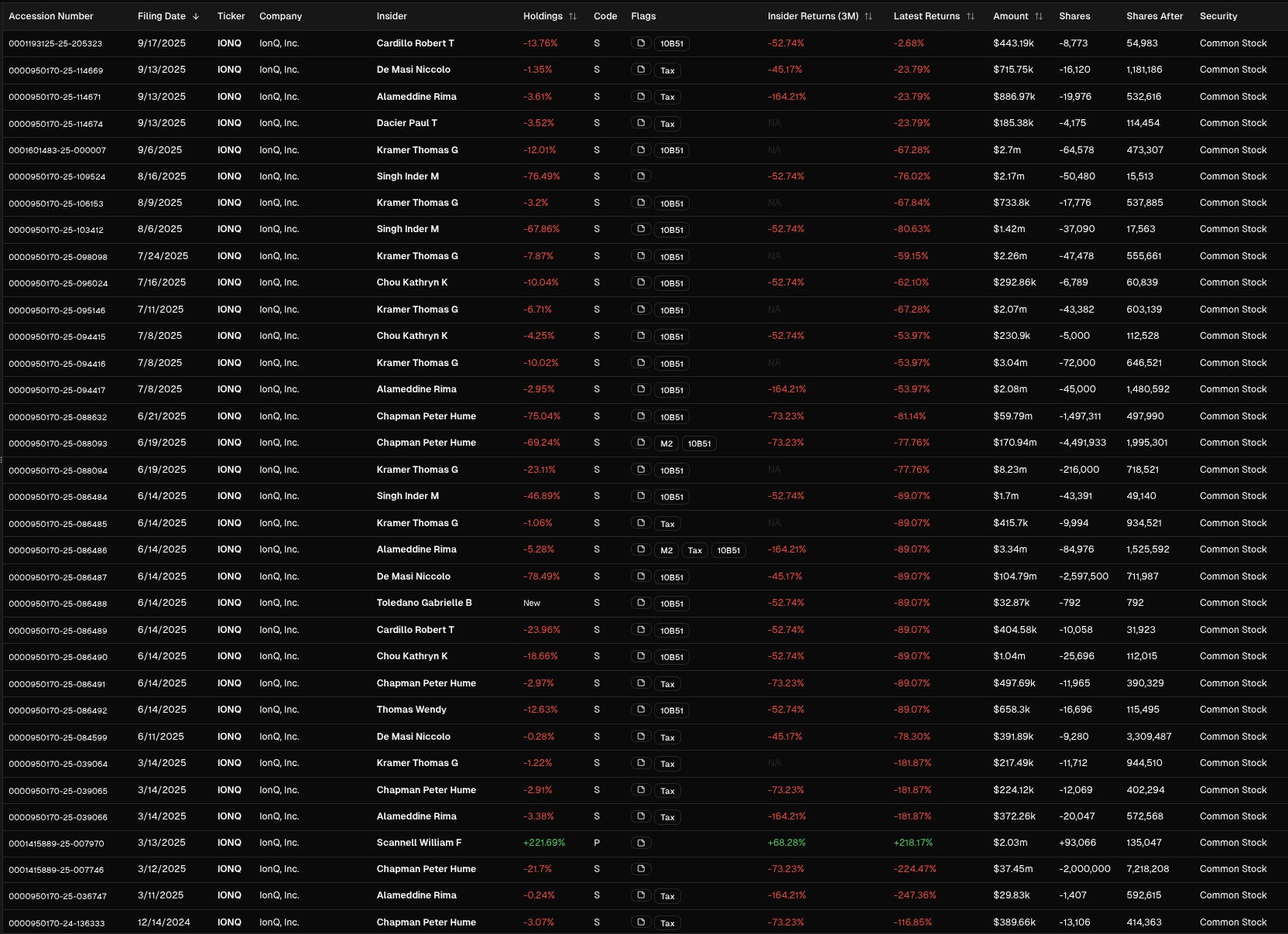
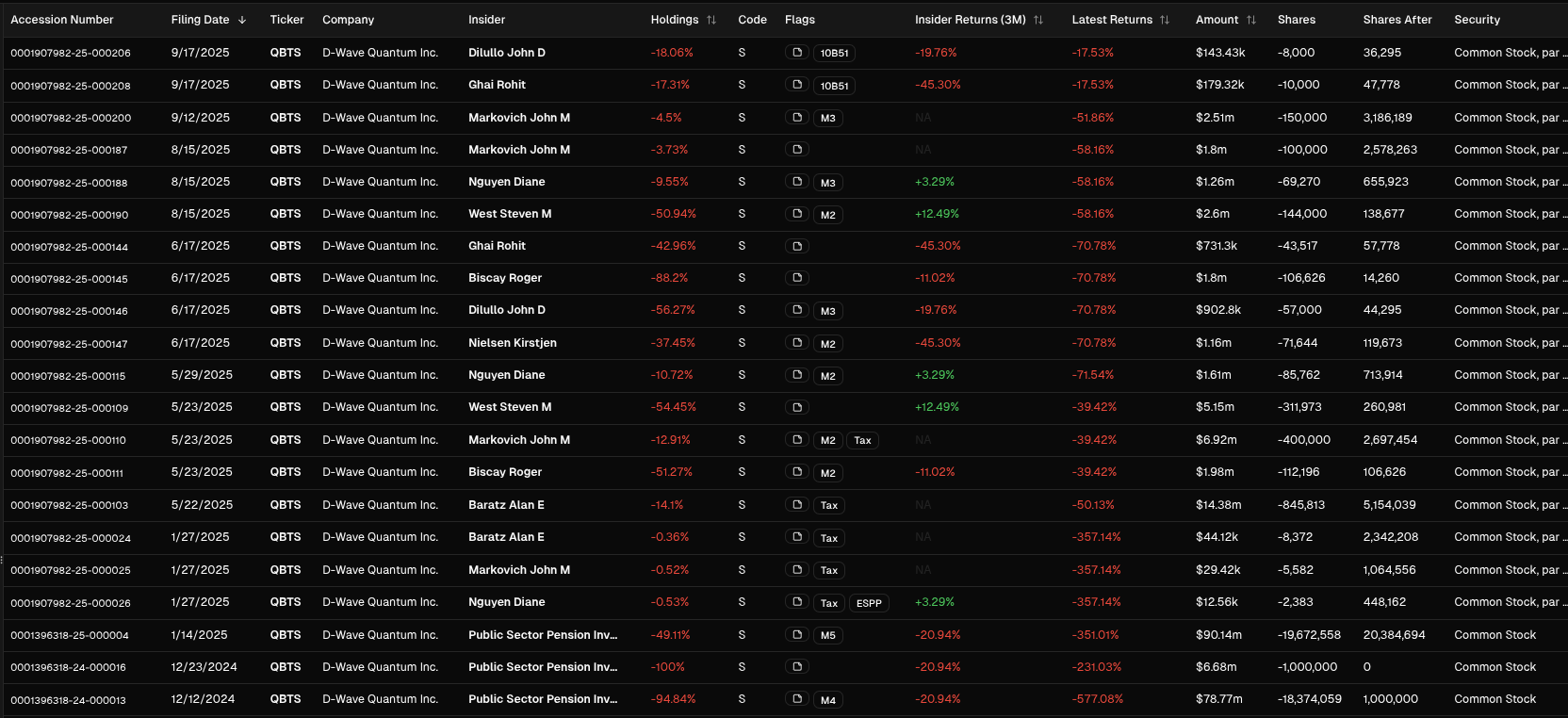
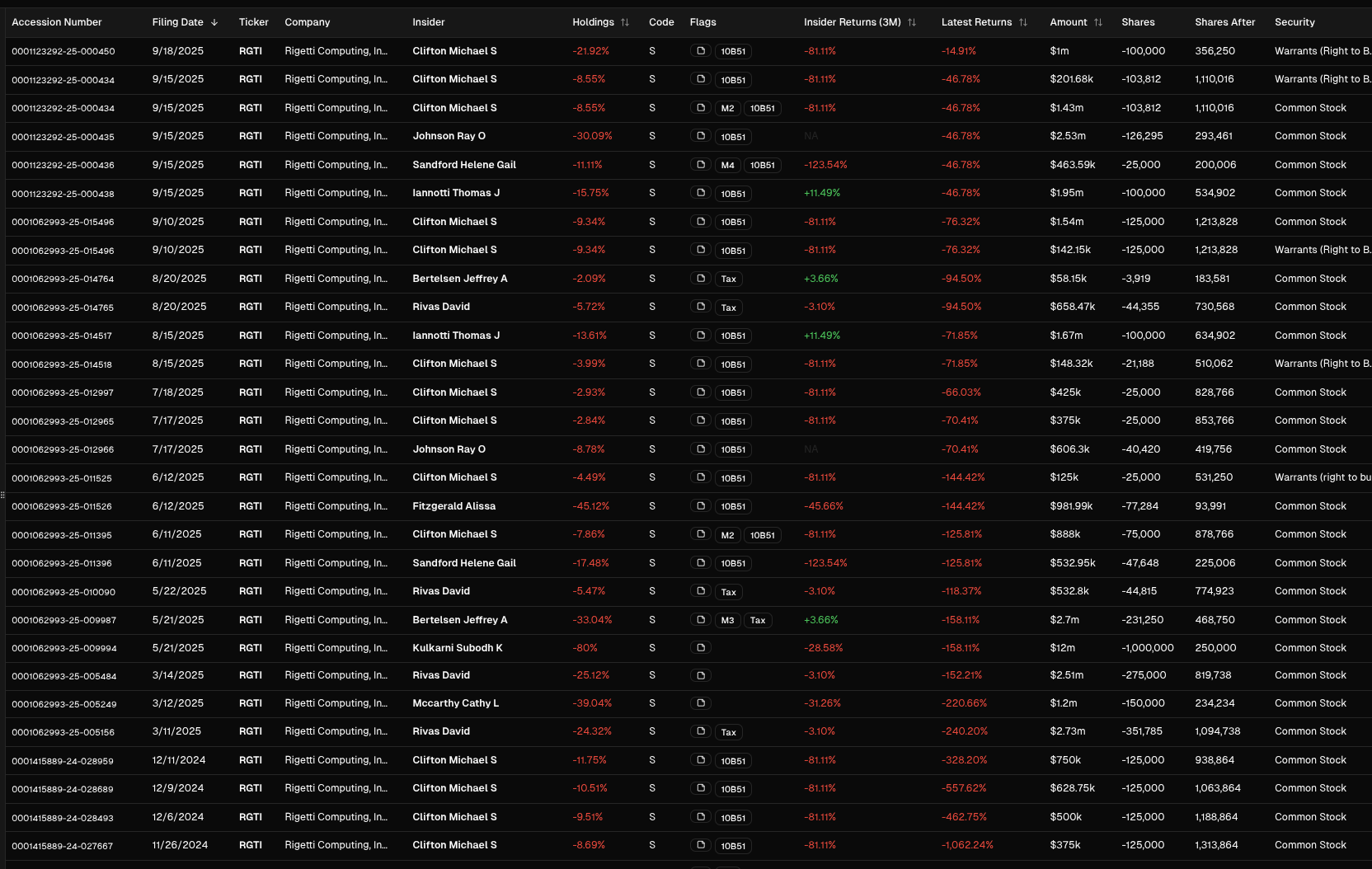
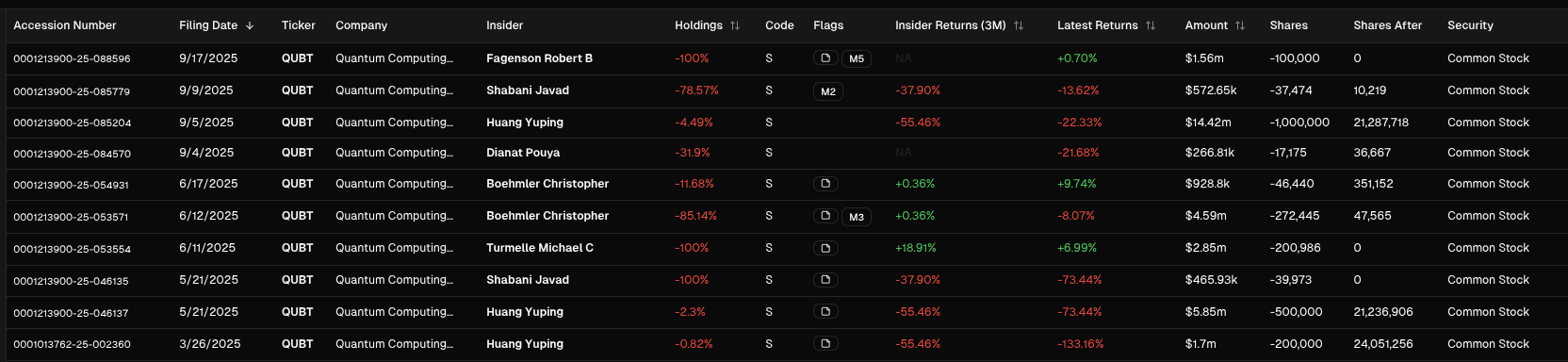
Insiders fully understand this and are dumping shares en masse. All the while, the CEO’s of IONQ, QBTS, and RGTI are non-stop promoting the stock by hosting investor days, appearing on Bloomberg [8] [10], appearing on podcasts, performing partnerships, creating fake cloud provider instances, and getting meaningless letters of intent from government agencies.
Quotes
Shamelessly reproduced from miser’s VIC write-up [2].
“These are hype companies, not quantum companies. Point blank.”
-Former senior executive at IonQ
“If we don’t need them and know that our tech is better and improving quicker, what’s the need? Why would we partner with IonQ?”
-Former senior executive at Quantinuum
“In quantum, I always had to exaggerate the sale, the value-add. It’s just not something I felt right doing.”
-Former senior executive at D-Wave
“We need at least 99.999999999% of fidelity to even start thinking about meaningful quantum advantage. And you’re in for a shock if you think that IonQ can hit quantum advantage at that error rate with just [100] qubits.”
-Current senior executive at large private competitor
"Quantum computing... is just a buzzword used for IR purposes."
-Former senior executive at Microsoft
Quantum Computation & Engineering
I will briefly review the more theoretical aspects of the field of quantum computing. This is not a full in-depth review of the field but a quick overview touching on the relevant highlights.
How does quantum computation work? What kinds of problems can be solved?
A classical bit exists as 0 or 1. A quantum bit (qubit) exists in superposition of 0 and 1 at the same time. By combining two qubits, you get a new state containing four states in superposition. This continues such that you get a superposition of 2^n basis states given n qubits. Through the use of quantum gates acting on this state, you can transform the amplitudes of this entire vector in each step. (Note that any multiple logic gate can be composed entirely from CNOT (controlled not) and single qubit gates.)
There is a caveat in measuring the result of these calculations though. By measuring its state, you destroy the 2^n basis states, collapsing it into only one of the basis states probabilistically based on amplitude, so naively, you would need an impractically large number of measurements to reconstruct the full state. This clearly won’t work in practice, so specialized algorithms have to be designed to counteract this. Methods to accomplish this include clever use of interference such that “wrong” answers cancel out and “right” answers grow in amplitude. If properly constructed, the one measurement you get is a useful one (e.g. the period in Shor’s algorithm).
The measurement limitation along with fundamental limitations like the no-cloning theorem, which prevents the existence of FANOUT among other useful system components, fundamentally restricts the addressable problem space. Despite all of this, we do know of certain problems that have a quantum speedup.
There are known speedups for certain structured combinatorial problems, but no evidence that NP-complete problems become efficiently solvable on a quantum computer. Even with the speedup, they still take an exponential amount of time. Also, the existing probabilistic algorithms used in practice today already get <1% error rate in less than a second.
Traveling Salesman Problem
Let’s take a concrete example with the Traveling Salesman Problem, which I restate as
"Given a list of cities and the distances between each pair of cities, what is the shortest possible route that visits each city exactly once and returns to the origin city?"
Solution Time Complexities
Brute force: O(n!) for classical vs O(sqrt(n!)) for quantum
Dynamic Programming (assuming quantum computers even have enough memory for this which they don’t): O(2^n) for classical vs O(1.728^n) for quantum
Experts accept that these polynomial speedups are not commercially useful. Existing solutions on classical computers already run in <1 second with <1% error rate using probabilistic algorithms.
Quantum Key Distribution & The Discrete Log Problem
Another use case is provably secure shared key distribution over an insecure line. This is due to the fact that the eavesdropper would have to destroy the qubit to evaluate its value, which can be detected by the receiving party. Note that this is not a new field. We have been sharing secrets over insecure lines for a long time with the Diffie–Hellman key exchange (DHKE), which works great but is not “provably secure”. The only situation where quantum key distribution is an improvement over DHKE is if you assume that the eavesdropper can solve the discrete log problem, which is only possible with a 2,300+ logical qubit computer currently with elliptic curve cryptography. If this is a worry, then there are post-quantum encryption methods that can be used like CRYSTALS-Kyber [6] and CRYSTALS-Dilithium [7]. These are still being standardized by NIST but will certainly be available before any QPU with >1k logical qubits exists.
Quantum key distribution is very sensitive to signal loss, which limits acceptable use cases. Even if a >2.3k logical qubit QPU were built, 99.9% of key exchanges would still happen with DHKE using post quantum cryptography methods. Only state-level actors would even be remotely interested in QKD over DHKE + post quantum cryptography. This vastly limits the real economic value of solving such a problem. Furthermore, Arqit ($ARQQ) and many others hold QKD patents. With IonQ’s acquisition of ID Quantique, they also own ~300 patents around QKD.
As one additional point on the discrete log problem with relation to blockchains, elliptic curves can certainly be hacked with a 2k-3k logical qubit quantum computer, but before this happens, all existing blockchains will move to a post-quantum encryption method.
Quantum Chemistry Simulations
This is the most interesting use case for quantum computing. In the early 1980s, Richard Feynman proposed that a quantum computer would be an effective tool with which to solve problems in physics and chemistry, given that it is exponentially costly to simulate large quantum systems with classical computers. While this is an interesting direction, it runs into practical challenges.
The most common task in quantum chemistry is ground-state energy estimation. The ground-state energy is the lowest possible energy a molecule can have, but solving for it exactly is usually impossible. Instead, scientists make a mathematical guess for how electrons behave and refine it step by step, lowering the energy until it can’t go any lower. In the paper “Is there evidence for exponential quantum advantage in quantum chemistry?”, it was determined that there is no generic exponential quantum advantage for this task [1]. Furthermore, both classical and quantum methods require heuristics, and with heuristics, classical simulation methods have polynomial time complexity. Furthermore, classical methods provide similar levels of ground-state energy estimation accuracy to much more complicated quantum algorithms.
Computational chemistry always competes with direct synthesis of the compound with subsequent analytical chemistry methods like x-ray crystallography or NMR spectroscopy. Even the leader in computational chemistry, Schrodinger, only earns $208M per year in revenue. This use case cannot support the existing $40B+ market cap.
LLM Fine Tuning
Quantum computing cannot handle trillions of in memory parameters + terabytes of unstructured training data. Quantum computers do not offer speedups for linear algebra. This will never be a use case for quantum.
Institutional Portfolio Rebalancing, Fantasy Sports Team Picking, AI Agent Assignment, Unit Commitment in Electric (from IONQ’s recent investor day presentation)
These represent either vanishingly small or non-existent TAM’s.
Engineering & Limitations
There are several physical realizations of quantum systems. The two main systems are ion trap and superconducting. Ion trap works at room temperature but requires insanely sensitive lasers to perform Doppler cooling of ions. The ions get trapped using a clever array of electrodes in a vacuum chamber. Note that IONQ’s CEO, Niccolo de Masi, claims that “these will run in your basement” unlike superconducting systems is unequivocally false. The ultra-high vaccum, fine-tuned lasers, high voltage trap electrodes, and regulated transport/handling of the ion isotopes is regulated. After cooling, the lasers can shoot photons at the ions, manipulating the quantum states for calculation with each photon-ion interaction serving as a quantum gate. These gates are chained together to form algorithms, with entanglement mediated by shared vibrational modes of the trapped ions.
Superconducting system qubits are built from tiny electrical circuits fabricated on a chip, cooled down to millikelvin temperatures inside dilution refrigerators. At these extreme conditions, certain metals become superconducting, meaning they conduct electricity with zero resistance. The qubits are realized using Josephson junctions, nanostructures that behave like nonlinear inductors, which allow engineers to create and control quantized energy levels in the circuit. Microwave pulses are then used to drive transitions between these levels, performing the equivalent of quantum logic gates.
While superconducting systems avoid the need for ultra-high vacuum and precision lasers, they trade those challenges for others: massive cryogenic infrastructure, vibration isolation, and complex microwave control electronics. The dilution refrigerators themselves are multi-ton devices costing millions of dollars, with significant engineering effort required just to maintain the operating environment. Despite this, superconducting qubits have proven highly scalable through existing semiconductor fabrication techniques, which is why companies like Google, IBM, and Rigetti have pursued them aggressively.
The core engineering implementation challenges for all of these systems are addressed through error correcting codes. These error correcting codes utilize multiple qubits to minimize error in a single qubit’s signal. Effectively this means that even when qubits are able to be manufactured, the majority of them are used to error correct. The ratio is postulated to be anywhere from 1:16 to 1:1000+. Note that the first “below-threshold” error correction (i.e. error codes that actually work at all) was demonstrated by Google with the Willow chip in Dec 2024. This shows you just how far quantum computing has to get to even get a handful of usable logical qubits.
Public Quantum: A Fraudster’s Paradise
With NVIDIA rising to the largest company in the world on the back of AI advancements and crypto at all time highs, retail is clearly moving out on the risk curve and looking for the “next NVIDIA”, a narrative played on by public quantum computing companies. Retail investors are drawn to this narrative, believing they are investing in a new technological revolution akin to the advent of the internet. This creates an environment ripe for executives who don’t mind making dubious claims to increase their share price.
All the while insiders are selling the vast majority of their shares. I believe such conduct could eventually draw regulatory scrutiny, as in the case of Nikola, which faced SEC action for overstating its technical maturity.
Technicals
I dislike looking at technicals as much as any other value investor, but when shorting, it’s a necessary part of the thesis.
It’s also interesting that Jane Street, Citadel, and other trading firms show up on the cap tables. I believe much of this ownership likely reflects derivative hedges rather than fundamental long exposure. Once momentum begins to stall and the premiums on calls fall, the inverse likely becomes true. These firms will sell puts and hedge with net short positions. This in combination with passive ETF’s has the effect of significantly accelerating the upward and downward momentum of moves in these stocks.
IonQ ($IONQ)
Short Interest: 15.7%
Days to cover: 2.2
Without any path to revenue, IONQ has turned to serial stock-based acquisitions to grow revenue inorganically. Their recent acquisition of Oxford Ionics has resulted in a ~9% dilution, 25,372,150 shares, event that will start by October 1st, 2025. Daily sales will be capped at 10% of the average 5 trailing days of trading volume, which is 4.2M shares, so it will take 6 days for Oxford Ionics insiders to completely sell out. This represents the single largest dilution event in IonQ’s history.
Some of the IonQ dilution events in 2025:
Sep 17, 2025 - agreement to buy Vector Atomic, Inc. for 6,294,058 shares
August 11, 2025 - 13,220,367 share offering
July 7, 2025 - $1.0 billion equity raise from Heights Capital Management for 14,165,708 shares and warrants to purchase 3,855,557 shares at $55.49
June 9, 2025 - 903,195 share offering
June 3, 2025 - Lightsynq Technologies Inc. for 12,377,433 shares
March 10, 2025 - ATM offering 16,038,460 shares
Including the Oxford Ionics deal, share count has expanded from 221.9M at the start of 2025 to 308.2M today, a 39% increase in just nine months. If this rate of dilution continues, shares will double over the next year and a half.
Ownership
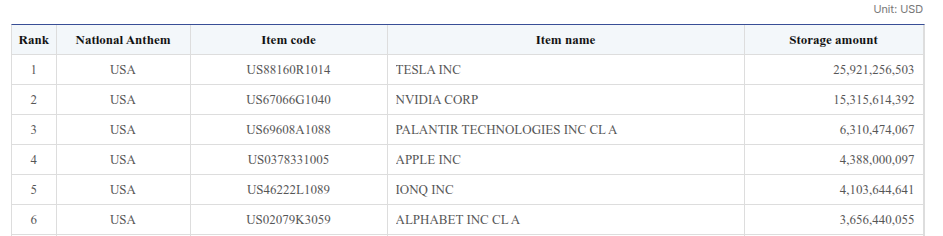
One thing to note. Korean is a large driver of buy pressure, owning 20.7% of all shares. With the general Korean stock market up 44% YTD, there is clearly a lot of liquidity floating around. Based on trading patterns and investor disclosures, we believe most of this ownership reflects speculative retail participation rather than long-term institutional conviction.
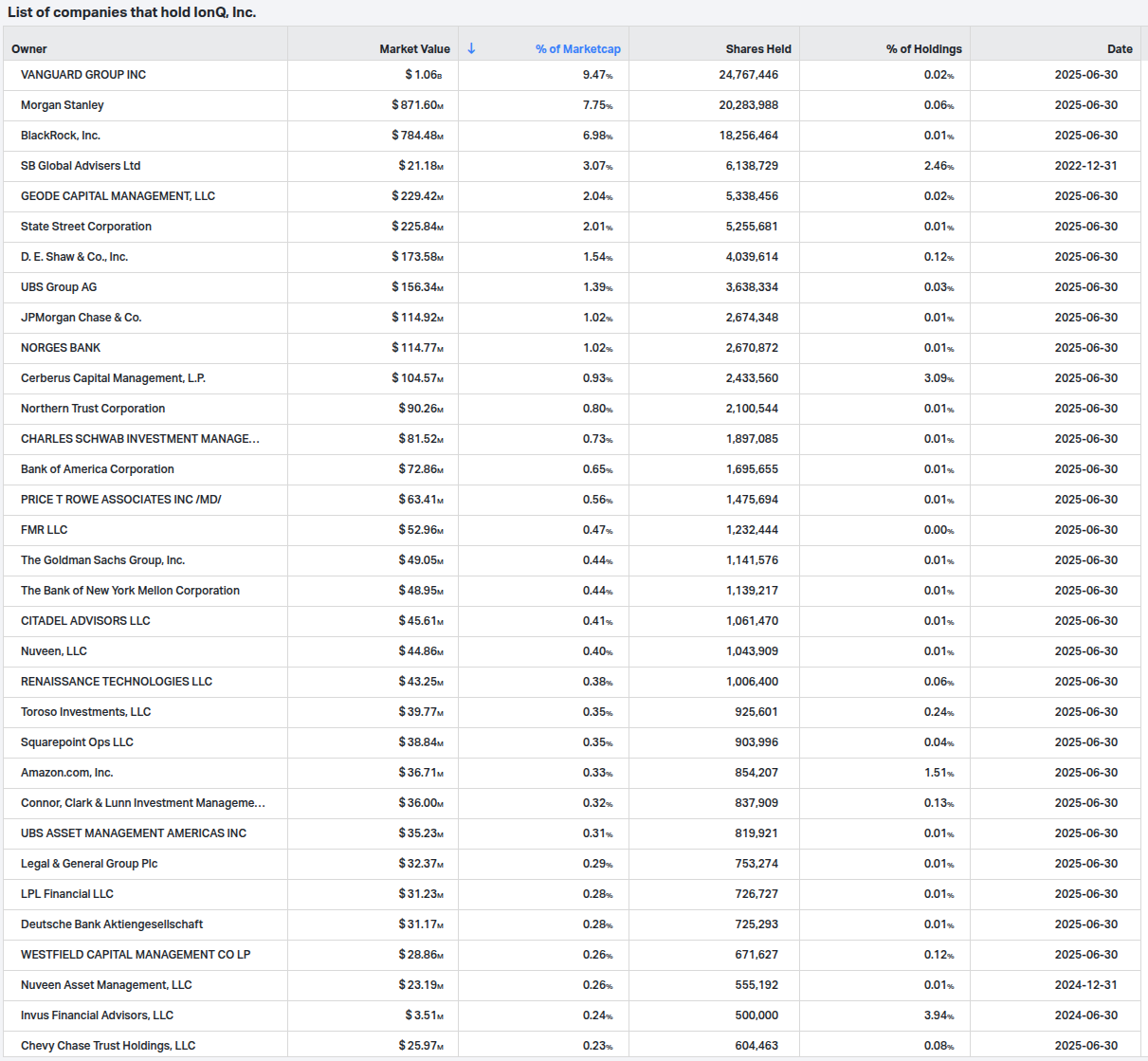
Institutional funds make up 54.6% of total ownership. I assume this is from mostly passive flows on account of how large the market cap is.
Gamma
Note that on Sep 26, 2025, 38.8k call options between strikes of 60 and 70 are expiring. This partially explains the quick run-up through the 60’s as funds short these calls hedged by buying 3.9M shares (1.3% of total shares outstanding). This open interest is more than 10x any other expiry date, summed across all strikes for a given expiry date. This unusually large concentration of open interest forced dealers to hedge by buying shares, artificially pushing the stock higher. As these contracts expire, the unwind of dealer hedges will create incremental selling pressure.
D-Wave Quantum ($QBTS)
Short Interest: 19.9%
Days to cover: 2.4
D-Wave Quantum is held by 51.3% institutions. I assume most of these are passive flows based on market cap.
Rigetti ($RGTI)
Short Interest: 16.0%
Days to cover: 1.41
Rigetti is held by 39.7% institutions. I assume most of these are passive flows based on market cap.
Quantum Computing Inc. ($QUBT)
Short Interest: 19.4%
Days to cover: 1.78
Quantum Computing Inc. is held by 36.0% institutions. I assume most of these are passive flows based on market cap.
FAQ
What about CUDA-Q from NVIDIA? Doesn’t that validate the whole market?
NVIDIA’s CUDA is the market leader in programming models for GPU’s. As a low-level developer, you can write code in a number of languages that then runs on any NVIDIA GPU. NVIDIA doesn’t see much opportunity in quantum, which is why they are not building out QPU’s themselves, but they want to hedge their bets in case significant applications for quantum are eventually found. By expanding CUDA to dominate how code is written for QPU’s, they still capture the developer market. As we’ve seen with CUDA once developers learn this programming model/paradigm/package, they don’t switch. Thus if quantum computing ever finds real applications, NVIDIA can simply change CUDA-Q to only support an NVIDIA QPU under the hood. This is a super low risk way for NVIDIA to lose little to no capital if quantum remains small and to capture most of the upside if quantum computing finds real applications, which again would be nothing short of a miracle for that to happen in the next decade. [4]
What about AWS Braket?
The obvious goal of AWS is to be your one stop shop for cloud computing. It’s a pretty clear business decision to build out a service for any form of computing. AWS makes high margin revenue whether quantum succeeds or fails in this case as an intermediary. The existence of AWS Braket in no way proves that quantum computing stocks will achieve attractive returns on capital at these levels. [5]
What about IonQ’s cloud instances on AWS?
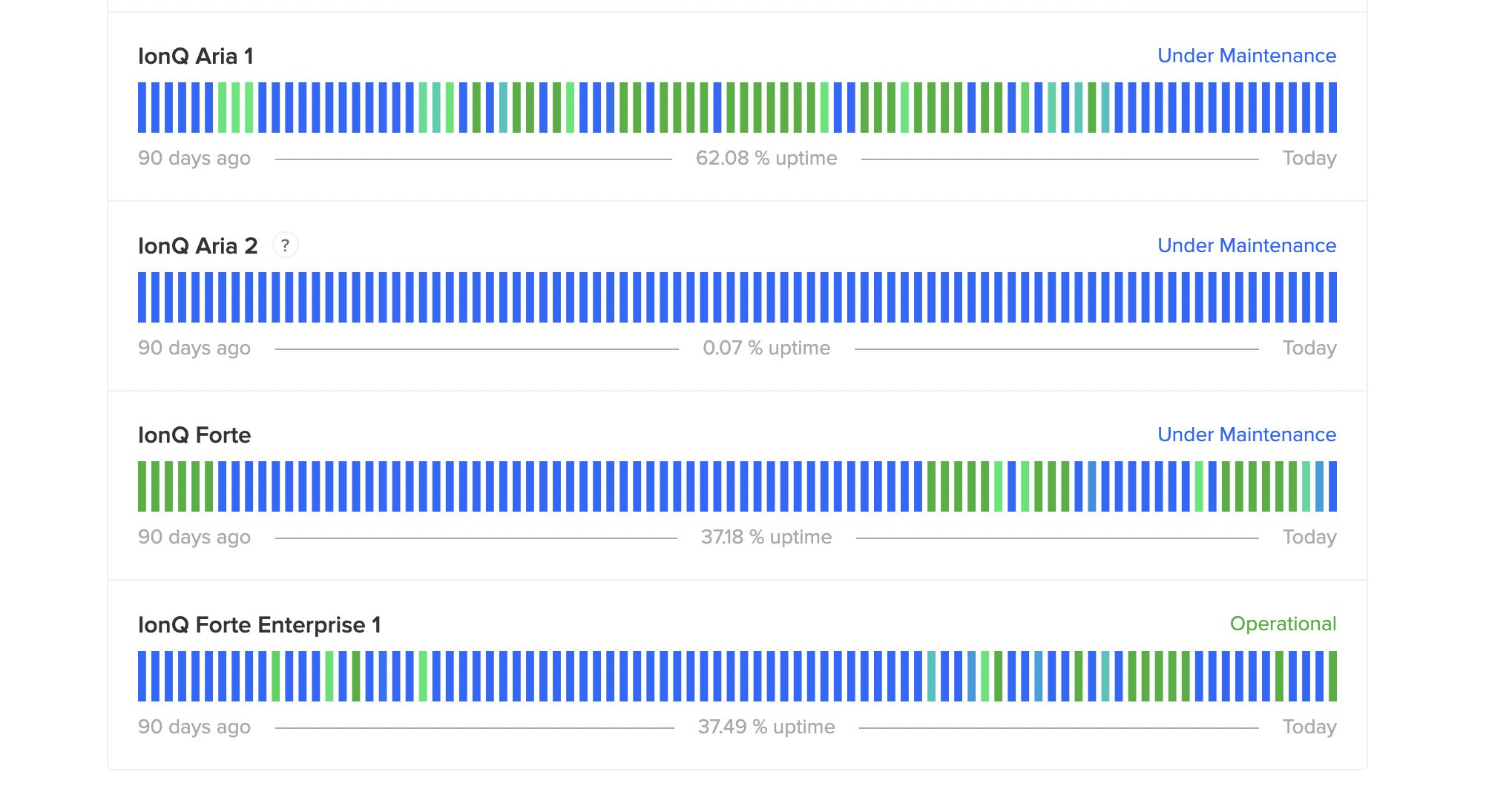
IonQ’s instances on AWS are almost always offline, and when they are online, they show no quantum speedups for quantum algorithms like Shor’s and commonly crash. They struggle to factor numbers like 21 and 77.
What about $XYZQ’s partnership with <random organization>?
Partnerships and press releases that sound nice mean absolutely nothing, especially if the product doesn’t fundamentally solve any real problem. These are primarily designed to generate headlines and fuel retail enthusiasm, rather than demonstrate genuine commercial progress.
What about quantum sensing?
Atomic clocks, gravimeters, and magnetometers are real devices with real use cases. However, these devices have been around for quite a while, TAM is limited, and there are many players in this space.
Why should I believe you?
Here’s a PhD in quantum computing from Cambridge explaining similar points.
Disclaimers
This report is for informational purposes only and does not constitute investment, legal, or tax advice. Nothing herein should be construed as a recommendation to buy or sell any security.
The information contained herein is obtained from public sources believed to be accurate, but no representation or warranty is made as to its completeness or accuracy.
The author of this report may have a financial interest in the securities discussed herein, including short positions. The author may change such positions at any time without notice.
The author disclaims any liability for losses incurred from the use of this report. Readers should conduct their own due diligence before making investment decisions.
References
“Is there evidence for exponential quantum advantage in quantum chemistry?” Seunghoon Lee¹, Joonho Lee², Huanchen Zhai¹, Yu Tong³, Alexander M. Dalzell⁴, Ashutosh Kumar⁵˒⁹, Phillip Helms¹, Johnnie Gray¹, Zhi-Hao Cui¹, Wen-Yuan Liu¹, Michael Kastoryano⁴˒⁶, Ryan Babbush⁷, John Preskill¹⁰˒⁴, David R. Reichman², Earl T. Campbell¹¹, Edward F. Valeev⁵, Lin Lin³˒⁸, and Garnet Kin-Lic Chan*¹ https://arxiv.org/pdf/2208.02199
https://valueinvestorsclub.com/idea/IONQ_INC/4707959129
https://blog.google/technology/research/google-willow-quantum-chip/
https://developer.nvidia.com/cuda-q
https://aws.amazon.com/braket/
https://medium.com/identity-beyond-borders/crystals-kyber-the-key-to-post-quantum-encryption-3154b305e7bd
https://eprint.iacr.org/2017/633.pdf
https://www.youtube.com/watch?v=DijNVVklr4g
www.youtube.com/watch?v=pDj1QhPOVBo
www.youtube.com/watch?v=zusNzlzrEQA
Thank you for your insightful and in-depth analysis of quantum computing stocks; it was truly enlightening for me.